

🐊 Editor's Note
Hey there,
Welcome back to another Don’t Feed The Algorithm, your weekly dispatch from Averi — where we explore the intersections of marketing, AI and the future of work.
There's a quiet shift happening, and it's easy to miss if you're only watching traffic dashboards.
This week, we dug into something that keeps coming up in our conversations with founders: the bots are picking favorites. Perplexity cites sources in 97% of its responses. ChatGPT? Just 16%. Google AI Overviews split the difference. Each platform has different preferences, different trust signals, different content it rewards. There's no "AI SEO" anymore — just three separate games with three separate rulebooks.
That sounds exhausting. But here's the part that makes it worth paying attention: AI search traffic converts at 5x the rate of traditional Google traffic. Smaller pond, bigger fish.
Meanwhile, GEO went from "thing we put in thought leadership pieces" to actual job descriptions. This week's job board includes dedicated Generative Engine Optimization roles at IHG, FirstKey Homes, and ClickHouse. Anthropic's hiring an SEO Lead for Claude. OpenAI wants a Vertical Marketing Lead. The infrastructure is getting built — fast.
And in "The Algorithm Could Never," we're featuring Jacquemus putting his 97-year-old grandmother in a campaign instead of a 22-year-old influencer with perfect metrics. It worked spectacularly. Because sometimes the most strategic thing you can do is be completely unpredictable.
The through-line? The systems are fragmenting, the playbooks are multiplying, and the winners are the ones who can read the room — not just the algorithm.
This week: what the bots are actually citing, a 90-minute GEO audit you can run before your next planning session, 9 AI marketing roles worth watching, and the data that explains why your About page might be tanking your AI visibility.
Let’s build.
— ZC & The Averi Team
⚙️ Straight Outta Dev

We hit 1.68 million Google impressions this month using the Averi Workflow
That's not a client. That's us.
We didn't build Averi based on a guess — we built it from the exact content strategy that's driving our own growth. Same playbook. Same system. Now productized so you can run it too.
Here's what actually moves the needle:
→ Topical authority over content volume. 12 tightly clustered articles outperform 50 disconnected posts. Every time.
→ Internal linking that compounds. Not an afterthought — the architecture that tells Google (and AI) you own the topic.
→ Optimized for where buyers actually search. Google rankings. ChatGPT citations. Perplexity answers. If your content isn't built for all three, you're leaving visibility on the table.
We're not asking you to trust a pitch. We're asking you to try the system that took us from zero to nearly 2 million monthly impressions in just 10 months — while everyone else was arguing about blog post frequency.
The Free beta is live and new features are being shipped daily based on the feedback from readers like you.
— Averi Team
🧪 Welcome to The Lab

Scaling content as a startup is f*cking hard.
Most advice is either too generic or written by people who've never shipped anything claiming to be a guru.
So we’ve launched r/startupcontentlab: a Reddit community for founders, engineers & marketers who are tired of sifting through the hordes of articles that just want your ‘click’ and don’t actually help you to build content engines that actually drive growth.
This is a place for real strategy, AI workflows, what's trending, and honest conversations about what's actually driving growth (and what's not). Just people figuring it out and sharing what they learn.
If you're building content systems to scale your startup, you'll fit right in.
Join our Reddit Community for Startup Founders building Content Engines to grow their businesses:
📝 The Good Sh*t

The Future of Storytelling: How AI Can Help Human Marketers Create Meaningful Connections
There's a moment in every great campfire story, right before the resolution, when the flames flicker and shadows dance across faces… where time seems to suspend itself.
Our ancestors knew this feeling intimately. Before the written word, before the printing press, before the algorithm, humans gathered in circles to share tales that would bind communities together and transmit wisdom across generations.
Now here we are, in an era where a machine can generate a thousand blog posts before your morning coffee cools, and we're left wondering… have we lost the fire?
The future of storytelling isn't about choosing between silicon and soul, it's about understanding what each does best and orchestrating them in symphony.
ChatGPT Has Ads Now. Here's What It Means for Your Startup's Content Strategy → Read online
AI Agents Won't Save Your Marketing (But AI Workflows Might) → Read online
🔥 In Case You Missed It…
ChatGPT ads are officially here — OpenAI launched ads on Feb 9 for free and Go tier users in the US. $60 CPM. $200K minimum buy-in. Ads appear at the bottom of responses, "clearly labeled and visually separated." Conversations won't influence answers, they claim. The timing? One day after Anthropic's Super Bowl ads mocked the entire concept. → Read OpenAI's announcement
Anthropic's Super Bowl ads worked — Claude saw an 11% jump in daily active users post-game and climbed to #7 on the App Store. The ads featured dead-eyed ChatGPT stand-ins pivoting mid-conversation to pitch "cougar dating sites" and height-boosting insoles. Tagline: "Ads are coming to AI. But not to Claude." Sam Altman called them "funny" but "clearly dishonest." The internet called his 420-word response even funnier. → Full breakdown from TechCrunch
Google's Discover core update is live — The February 2026 update targets clickbait, rewards local relevance, and evaluates expertise topic-by-topic. Translation: a local news site with a killer gardening section can now outrank a generic lifestyle blog on gardening queries. Thin AI-generated content is getting hit hardest. → Google's official announcement
Meta's Threads ads go global — 400M+ monthly users will now see ads in their feeds. The rollout started the first week of February and uses the same AI-driven personalization as Instagram and Facebook. Threads has officially surpassed X in daily mobile users. The monetization era has arrived. → CNBC coverage
Perplexity launched Model Council — Max subscribers can now run queries through three AI models simultaneously (Claude Opus 4.6, GPT-5.2, Gemini 3 Pro), compare answers side-by-side, and get a synthesized consensus. Deep Research now runs on Claude Opus 4.5 and outperforms competitors on accuracy benchmarks. Memory improved to 95% recall, up from 77%. → Perplexity changelog
AI Overviews are crushing click-through rates — New Ahrefs data shows AI Overviews reduce CTR for #1 rankings by 58%, up from 34.5% just eight months ago. A separate Seer Interactive study found organic CTR on AIO queries dropped from 1.76% to 0.61%. If you're ranking first and an AI Overview appears, you're getting roughly half the clicks you would've two years ago. → Full analysis
Anthropic closed a $30B funding round — Valuation: $380B. That's more than double their September raise. The round came days after their Super Bowl campaign and the same week OpenAI launched ads. Both companies are reportedly planning IPOs by end of 2026. → CNBC report
Google's adding shopping to AI Mode — Users can now buy from Etsy and Wayfair directly within Gemini. A new "Direct Offers" feature lets brands offer discounts inside AI Mode responses. The line between AI assistant and AI storefront is officially gone. → Bloomberg coverage
🕵 Marketer’s Anonymous
We all know the industry loves to pretend it’s got it all figured out.
But here?
We tell the truth.
Every week, we’re asking you to share how things really work behind the scenes. Because getting better starts with getting honest.
Don’t worry, it’s a safe space.
Drop your vote.
📺 The Algorithm Could Never
Jacquemus — "The Original Icon"
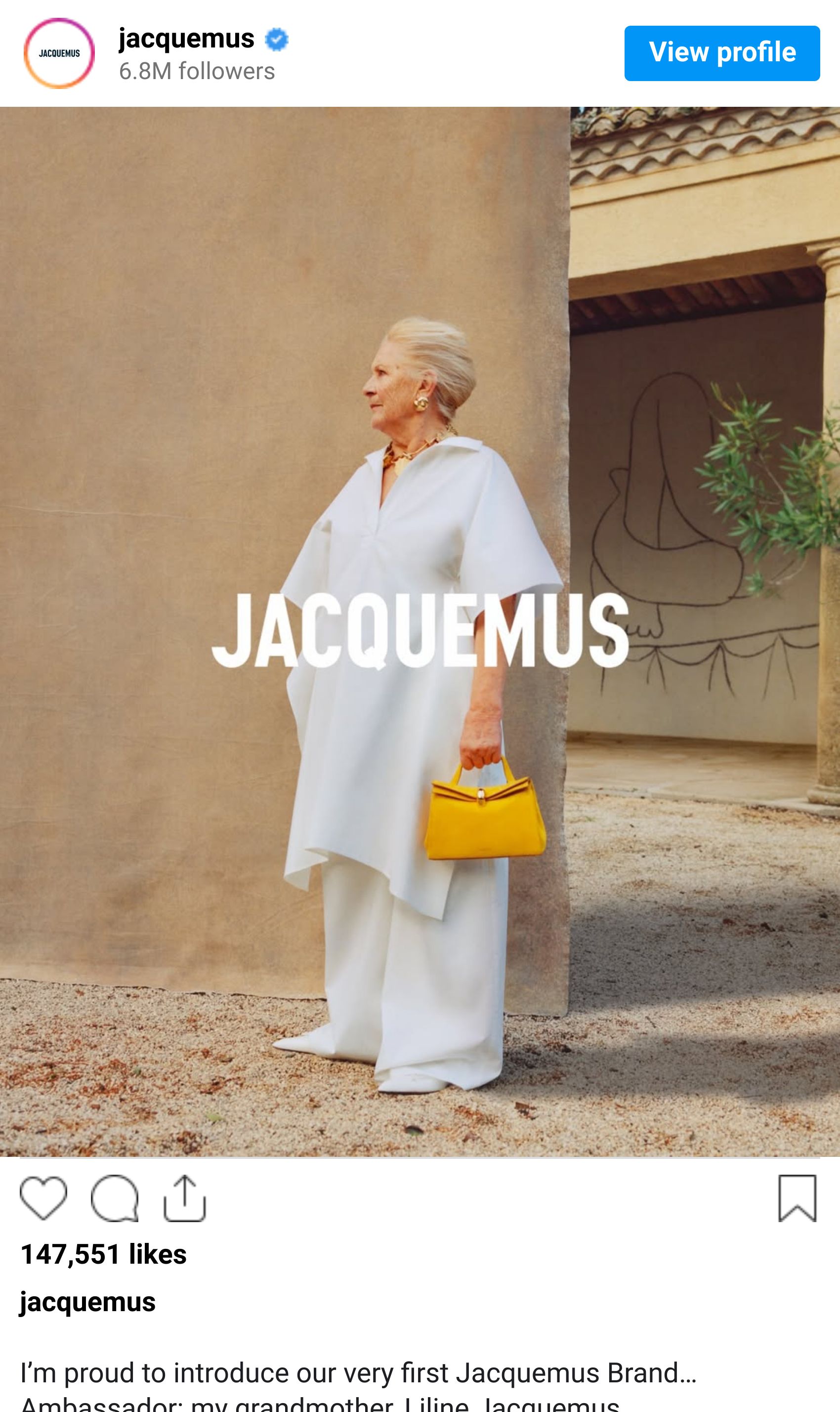
When Jacquemus teased its first-ever brand ambassador, the fashion world assumed the obvious: Kendall Jenner. Lisa from BLACKPINK. Bad Bunny. Someone with millions of followers and a face that moves product.
Instead, Simon Porte Jacquemus chose his 79-year-old grandmother, Liline.
Born in 1946 in Alleins, a tiny village in the south of France, Liline grew up in a farming family raised by an Italian single mother. She's never been an influencer. She doesn't have a public Instagram. She's simply the woman who shaped Simon's vision of elegance, authenticity, and strength — the qualities that built a billion-dollar fashion house.
The announcement came with a satirical "ambassador contract" requiring Liline to never use the word "brand" (only "family"), never wear other designers ("even in dreams"), and always smile. It was playful, warm, and disarmingly human.
The Result:
The announcement dominated fashion media for days. WWD, Vogue, and lifestyle publications covered it as both news and cultural commentary. The imagery — Liline in pristine Jacquemus, holding the Valérie bag named after Simon's late mother — went viral not for its production value but for what it represented: a luxury brand choosing meaning over metrics.
The move cemented Jacquemus's positioning as a fashion house built on heritage and heart, not algorithmic optimization. In an industry racing to sign the same rotating cast of celebrities, they zigged hard — and owned the conversation.
Why We Love It:
An AI optimizing for ambassador ROI would have flagged this immediately:
⚠️ "Ambassador has 0 social media following — projected reach: NEGLIGIBLE" ⚠️ "Age demographic (79) outside target consumer profile (18-34)" ⚠️ "No prior brand ambassador experience detected — engagement risk: HIGH" ⚠️ "Competitor analysis: 94% of luxury ambassador selections are celebrities with 10M+ followers" ⚠️ "Recommendation: Consider Lisa (BLACKPINK) — 103M followers, proven luxury conversion"
Every data model would have been right. Every influencer marketing platform would have ranked Liline dead last.
But Jacquemus understood what the algorithm couldn't: authenticity has no follower count. In a world where every brand is chasing the same celebrities, the most disruptive choice is the one that actually means something. Liline isn't an ambassador — she's the reason the brand exists.
Sometimes the most powerful marketing decision is choosing the story that's already true.
Want to see more of the best marketed companies on the planet? 👇
🗓️ Make Friends
DeveloperWeek 2026 | San Jose, CA | Feb 18-20 | → Register
Product Marketing Summit | Austin, TX | Feb 24-25 | → Register
Social Media Strategies Summit | Virtual | Feb 25-26 | → Register
AI & Big Data Expo Europe | Amsterdam, NL | Feb 17-18 | → Register
Social Fresh 2026
The original social media conference returns to NYC for two days of exclusive case studies, consumer trend reports, and creative performance insights. Sessions span social, content, creator/influencer, paid media, and AI—all designed for practitioners who actually do the work. Speakers from Microsoft, Meta, Marriott, and Vanguard.
Date: March 19-20, 2026
Location: New York, NY
Link: Register
Shoptalk Spring 2026
10,000+ retail and ecommerce leaders descend on Vegas for three days themed "Retail in the Age of AI." Speakers from OpenAI, Walmart, Victoria's Secret, Meta, and Reddit. Sessions cover AEO/GEO tactics, retail media innovation, and AI agents. One in three attendees holds a C-suite role.
Date: March 24-26, 2026
Location: Las Vegas, NV
Link: Register
🤖 What The Bots Are Reading
The Citation Gap: Why 84% of Your AI Visibility Strategy Might Be Wasted
New data reveals a stark truth, most content never gets cited by AI — and the platforms that do cite have wildly different standards.
The headline number: Perplexity cites sources in 97% of responses. Google AI Overviews? 34%. ChatGPT? Just 16%. And Gemini provides zero clickable citations in 92% of its answers.
Translation: if you're optimizing for "AI search" as a monolith, you're optimizing for nothing.
Where each bot shops for answers:
🔍 Perplexity → Real-time web search on every query. Cites multiple sources per response. Reddit-heavy (46.5% of top citations). Rewards freshness and direct answers. Traffic is trackable in GA4.
🤖 ChatGPT → Searches only when browsing is enabled. 24% of responses generated with zero web fetches. When it does cite, Wikipedia dominates (47.9% of top citations). Prefers encyclopedic authority.
🌐 Google AI Overviews → Most balanced sourcing. Reddit (21%), YouTube (18.8%), Quora (14.3%). Favors diversified cross-platform presence. 93.67% of citations link to top-10 organic results — but only 4.5% match Page 1 URLs exactly.
The conversion kicker: AI search traffic converts at 4.4x the rate of traditional Google traffic. The catch? You're competing for dramatically fewer citation slots.
What gets you in the door:
Lead with the answer. First paragraph should directly answer the query — no throat-clearing intros
Structure for extraction. Content with clear headings and lists is 3x more likely to be cited
Specificity wins. "The best X is Y" outperforms "Y might be good" — definitive statements get quoted
Schema markup matters. Article, FAQ, and HowTo schemas help AI parse your content accurately
Video is disproportionately cited. YouTube transcripts with chapter markers show up across all platforms
What keeps you invisible:
Long paragraphs without summaries (AI systems timeout at 1-5 seconds)
Missing author bylines and credentials
Blocking AI crawlers (GPTBot, ClaudeBot, PerplexityBot) in robots.txt
Relying on Google rankings alone — only 12% of ChatGPT citations match Page 1 URLs
The bottom line: There's no universal "AI SEO" anymore. Perplexity rewards real-time relevance and Reddit presence. ChatGPT rewards Wikipedia-style authority. Google AI Overviews reward platform diversity.
Pick your platform based on where your audience actually searches — then optimize accordingly.
→ The GEO Playbook 2026: Getting Cited by LLMs | → How to Get Cited by ChatGPT, Perplexity & AI Search
💡Ask Averi
AI + Human Marketing Tip
"Your "About Us" page is probably tanking your AI search visibility."
Here's why: LLMs pull entity information from your site to understand who you are before deciding whether to cite you. If your About page reads like a vague mission statement ("We're passionate about delivering innovative solutions..."), AI systems can't figure out what you actually do — or why you're credible.
Quick fix: Rewrite your About page like a Wikipedia entry. Lead with a clear, factual definition: "[Company Name] is a [specific category] that helps [specific audience] achieve [specific outcome]." Include founding year, headquarters, notable customers or investors, and 2-3 concrete proof points.
This isn't just about AI. It's about clarity. The companies that can describe themselves in one sentence are the ones that get remembered — by humans and machines.
Strategy You Can Steal
The "GEO Audit Sprint" — 90 Minutes to AI Search Readiness
Most startups know they should be optimizing for ChatGPT, Perplexity, and Google AI Overviews. Almost none of them have actually checked whether they're showing up. Here's how to run a quick GEO audit before your next planning session:
Block 1: Discovery Check (30 min)
Open ChatGPT, Perplexity, and Google (with AI Overviews enabled). Ask each one:
"What is [your company name]?"
"What are the best [your category] tools for [your ICP]?"
"How do I solve [problem your product solves]?"
Screenshot every response. Note: Are you mentioned? Are you cited? Are competitors showing up instead? This is your baseline.
Block 2: Citation Trace (30 min)
For every competitor that does get cited, click through to the source. Ask yourself:
What type of content is being pulled? (Blog post? Product page? Third-party review?)
How is the content structured? (Clear definitions? Stats? FAQ format?)
Where is it published? (Company site? Industry publication? Reddit?)
Pattern recognition here is everything. LLMs have preferences — figure out what they're rewarding in your space.
Block 3: Gap Map (30 min)
Compare what you found to what you have. Build a simple 3-column doc:
Column 1: Questions/topics where competitors get cited and you don't
Column 2: Content you already have that should be ranking (but isn't structured for AI)
Column 3: Content you need to create from scratch
Prioritize Column 2 first — restructuring existing content is faster than creating new. Add schema markup, clearer definitions, and direct answers in the first 100 words.
The output: You now have a prioritized GEO roadmap that took 90 minutes instead of a $15K agency audit. Run this quarterly. The landscape is shifting fast.
This is the exact sprint we run with early Averi users before building their content strategy — because you can't optimize for visibility you haven't measured.
💼 Don’t Let AI Replace You
Anthropic
Position: SEO Lead – San Francisco, CA
Own organic search strategy and technical SEO infrastructure across Anthropic's web properties. You'll define how Claude gets discovered. → Apply Now
Anthropic
Position: Creative Director, Copy & Content – San Francisco / New York
Define and evolve brand voice and tone for Anthropic and Claude. Own creative strategy for marketing campaigns, product comms, web content, and thought leadership. $320K-$400K. → Apply Now
Anthropic
Position: Video Director, Product Launches – San Francisco, CA
Lead video creative strategy for Claude's product launches and marketing moments. Shape how the world sees AI safety in action. → Apply Now
OpenAI
Position: Integrated Marketing Manager – U.S. (Remote Hybrid)
Drive integrated marketing campaigns for ChatGPT and OpenAI's product ecosystem. Help shape how millions discover and adopt AI. → Apply Now
OpenAI
Position: Vertical Marketing Lead – San Francisco, CA
Build industry-specific go-to-market strategies for OpenAI's priority verticals. Create compelling playbooks, narratives, and customer stories that empower enterprise sales. → Apply Now
HubSpot
Position: Manager, Marketing Technology – AI – Cambridge, MA (Remote)
Lead a team of AI "Experience Engineers" to incorporate AI into HubSpot's marketing strategy. You'll work with executive leadership on AI strategy and partner across the business to realize the vision. → Apply Now
IHG Hotels & Resorts
Position: GEO Lead (Generative Engine Optimization) – New York, NY (Hybrid)
Define and execute enterprise strategy for AI search optimization. Ensure IHG's brands, destinations, and hotels are discoverable across ChatGPT, Perplexity, and Google AI Overviews. $75-$80/hr contract-to-hire. → Apply Now
FirstKey Homes
Position: Manager, Organic & AI Search Optimization – Remote
Lead unified AEO/GEO strategy combining technical SEO with AI-driven discovery. Optimize for knowledge panels, rich snippets, and AI-generated results across ChatGPT, Google AI Overview, and Perplexity. → Apply Now
ClickHouse
Position: Product Marketing Engineer – GEO, AEO & SEO – Remote
Own strategy for generative and answer-engine optimization. Ensure ClickHouse appears in AI Overviews, featured snippets, and conversational search results. → Apply Now
Did You Know? — Only 22% of marketers are actively tracking AI visibility and traffic — yet AI search visitors convert at 14.2% compared to Google's 2.8% (that's 5x higher). Meanwhile, Gen AI traffic is growing 165x faster than organic search traffic.
The opportunity gap is massive, and most of your competitors aren't even watching the scoreboard.
Til next time,
