

🐊 Editor's Note
Concentration.
TL;DR this week:
🏆 The top 15 domains capture 68% of all AI citations across ChatGPT, Perplexity, Gemini, Claude, and Google AI Overviews (680M citations analyzed)
🔴 Adobe acquired Semrush for $1.9 billion — the SEO industry now has a new owner
📱 Google replaced "Search" with "Ask Google" on Android and pushed AI Mode into the default search bar
Fifteen. That's how many websites decide whether AI engines have ever heard of you.
The 5W study that dropped this week analyzed 680 million citations across every major AI platform and found that 68% of all citations come from just 15 domains. YouTube overtook Reddit at the top. LinkedIn jumped from rank 11 to rank 5 on ChatGPT in three months. A single Google parameter change caused ChatGPT's Reddit citation share to collapse from 60% to 10% in six weeks. The set is small, and it's not stable.
Meanwhile, Adobe closed the $1.9 billion Semrush acquisition and folded SEO, GEO, and "agentic search optimization" into its enterprise CX stack. Google replaced the word "Search" with "Ask Google" on every Android device — the UI shift that makes AI Mode the default, not the option. And Anthropic, HubSpot, and Sprinklr all shipped agentic features in the same seven-day window, accelerating the rebrand from "marketing automation" to "agent orchestration."
The room is getting smaller. The platforms are consolidating. The citation economy is concentrating into fewer sources, fewer domains, fewer seats at the table. That's bad news if you're waiting. It's the best news possible if you're building — because the playbook for earning one of those seats is exactly what we've been teaching in Feed the Engine for six weeks running: original data, entity density, clean structure, content freshness, and distribution on the platforms AI engines already trust.
This week's Strategy You Can Steal is a 90-minute citation audit built around the 5W data. The Algorithm Could Never features IRN-BRU's 125th anniversary tattoo parlor — a loyalty test most brands wouldn't dare attempt. And we published the Averi case study I've been putting off for months… 10 million Google impressions, one-person team, twelve months of receipts.
Fifteen seats. Build for one of them.
Let’s build.
— ZC
We published our 10M impressions case study this week. What's the one metric you wish you could show your board or your co-founder but can't yet? Hit reply — best answers go in next week's issue.
🤓 Be The Smartest In The Slack
This week's term: AEO (Answer Engine Optimization)
AEO is the practice of optimizing your content to appear as the answer inside AI-generated responses — not just ranked in a list of links. When someone asks ChatGPT "what's the best content engine for startups?" and it answers with a specific brand, that brand won the AEO game. When it doesn't mention you, you lost it.
AEO isn't a replacement for SEO. It's the layer on top. SEO gets your page indexed and ranked. AEO gets your page retrieved, read, and cited by the AI that's now sitting between your content and the person who asked the question. HubSpot just launched a $50/month AEO product. Stripe has AEO in a job title. The term went from research paper to budget line in under a year.
Next time someone in your Slack says "should we be doing GEO?" you can say: "GEO is one framework. AEO is the umbrella. Same goal — get cited by the machines — different people named it different things."
Then send them this newsletter.
🔥 In Case You Missed It…
Adobe closes the $1.9B Semrush deal — and the SEO industry has a new owner. On April 28, Adobe completed its $1.9 billion all-cash acquisition of Semrush at $12 per share. Semrush is now a wholly owned subsidiary, and Adobe is folding its SEO, GEO, and "agentic search optimization" capabilities into Adobe CX Enterprise. Adobe's pitch to advertisers is data-backed: AI traffic to U.S. retail sites jumped 269% year over year in March 2026, and most brands have no system for measuring how AI engines see them. SEMR was delisted from the NYSE the morning the deal closed. → Adobe · Constellation Research
OpenAI shipped GPT-5.5 — and quietly bought another startup. GPT-5.5 dropped April 24 to Plus, Pro, Business, and Enterprise users in ChatGPT and Codex, positioned as OpenAI's strongest model for agentic, multi-step research and coding work. A week later, OpenAI announced its seventh known acqui-hire of 2026: AI personal-finance startup Hiro Finance, whose ten-person team joins OpenAI while Hiro shuts down operations on April 20 and deletes user data on May 13. The pattern is consistent — keep the talent, close the product. → CNBC · Crunchbase
Anthropic ships Opus 4.7, plus Routines and Claude Design. Claude Opus 4.7 went generally available April 16 with high-resolution image support up to 3.75MP, an "xhigh" reasoning effort level, and task budgets that let Claude target a token ceiling per agentic loop. Anthropic also released Routines, a feature that lets Claude run scheduled or webhook-triggered jobs unattended, and Claude Design, a research-preview visual assistant that turns prompts and codebases into prototypes, decks, and marketing collateral. Pro, Max, Team, and Enterprise tiers all get access. → Anthropic · GitHub Changelog
Google AI Mode hits 75M daily users — and replaces "Search" on Android. AI Mode is now processing over one billion queries per month with 75 million daily active users. On April 29, Google replaced the "Search" prompt in the Android search bar with "Ask Google" and pushed AI Mode directly into the bar, dropping the iconic G logo for a plus menu. Chrome desktop also added side-by-side viewing so users can read source pages without leaving AI Mode. The shift from "search" to "ask" is no longer a positioning slide — it's a default UI. → 9to5Google · Google Blog
YouTube overtakes Reddit as the #1 AI citation source. New research published this week shows YouTube now appears in roughly 16% of AI-generated answers, compared to Reddit's 10%, the first time YouTube has held the top slot since AI search citation tracking began. LinkedIn jumped from rank 11 to rank 5 on ChatGPT in three months. The 5W AI Platform Citation Source Index, which aggregated 680 million citations from August 2024 to April 2026, found that the top 15 domains now capture 68% of all citations across ChatGPT, Perplexity, Gemini, Claude, and Google AI Overviews. → Adweek · PR Newswire
AI Overviews CTR is rebounding — but only for brands that get cited. Seer Interactive's latest data shows organic CTR on AI Overview-present queries climbed from 1.3% in December 2025 to 2.4% in February 2026 — still well below the pre-AIO baseline of 1.76%, but a real recovery. The interesting cut: brands cited inside an AI Overview earn 35% more organic clicks and 91% more paid clicks than brands competing only for the link below. Citation has become its own ranking factor. → Seer Interactive · Amsive
Anthropic and OpenAI both launch enterprise joint ventures the same day. On May 4, both labs announced new joint-venture arms aimed at running enterprise AI deployments — bundled implementation, services, and revenue-share contracts targeting Fortune 500 buyers. The structures differ, but the read is the same: model APIs alone aren't moving the enterprise needle fast enough, and both companies want a seat at the integration table. Expect a Big Four consulting response within the quarter. → TechCrunch
HubSpot, Sprinklr, and BlueConic all shipped agentic features in the last 7 days. HubSpot's Spring 2026 Spotlight introduced HubSpot AEO and a Prospecting Agent built on its agentic customer platform. Sprinklr unveiled an AI-native CX platform release with automated governance and conversational service bots. BlueConic launched "Growth Plays," pre-built workflows that segment customers by purchase likelihood and trigger messages off prior site behavior. The product category formerly known as "marketing automation" is becoming "agent orchestration" — and the rebrand is happening fast. → MarTech · contentmarketing.ai
💡Strategy You Can Steal: The 90-Minute Citation Audit
What it is: If you ship one piece of work this week, make it this one. You're going to take inventory of your existing content, pick the three pieces with citation potential, and rebuild them into AI-engine-ready assets.
Time commitment: 90 minutes.
Block 1 — Inventory (15 minutes)
Open Google Search Console. Filter to your top 25 pages by impressions over the last 90 days. Drop them into a spreadsheet with three columns: URL, current organic impressions, current word count. You can pull word counts in bulk with a free tool like Sitebulb or just eyeball your CMS. The point is to see which pages are already earning attention — those are the ones AI engines might already be sampling.
Block 2 — Score (20 minutes)
Apply a five-point citation score to each page. One point each for: (1) over 20,000 characters, (2) clean H1 → H2 → H3 hierarchy, (3) contains original data with a methodology, (4) cites at least three authoritative sources with hyperlinks, (5) includes an FAQ section with extractable 40-60 word answers. Anything scoring 4 or 5 is already citable. Anything scoring 0 or 1 is dead weight — deprioritize it. Your target is the 2-3 score pages, where one focused edit moves them into the citable bracket.
Block 3 — Pick three and rebuild (40 minutes)
Choose three pages with scores of 2 or 3. For each, do exactly one thing: add original data. Run a survey of 50 people in your audience. Pull a benchmark from your own product analytics. Calculate a ratio nobody else has bothered to calculate. Then write a 150-200 word section explaining your methodology — sample size, time period, what you measured, what you excluded. AI engines will cite a number with a methodology faster than they'll cite a number without one. Add the section under a new H2 like "What we found in our [X] study."
Block 4 — Distribute (15 minutes)
This is where most teams stop and lose half the value. Take the original stat from each page and post it three places: a LinkedIn carousel, a Reddit comment in a relevant subreddit (responding to an actual question, not promoting), and a YouTube short with the stat on screen. Those three platforms are now in the top 5 most-cited domains across every AI engine. The same data point published in four places — your site, LinkedIn, Reddit, YouTube — gets pulled into AI answers at roughly 3x the rate of the same data published only on your blog.
Why this works: This week's 5W study showed that AI engines pull from the same 15 domains for 68% of all citations, and pages over 20,000 characters earn 4.3x more citations than short ones. The 90-minute sprint targets the exact intersection of those two signals — long, well-structured pages with original data, distributed on the platforms AI engines already trust. You're not trying to outrank anyone. You're trying to be the source. That's a different game with a much narrower playing field.
Want help finding which of your existing posts have the highest citation potential?
Averi runs the audit automatically against your full library and queues the rewrites for you. → Try it free
👾 Feed The Engine

This week: Content Freshness
76.4% of ChatGPT's top-cited pages were updated within the last 30 days. Pages not updated within 90 days lost 20-40% of their organic traffic in Google's March core update. Freshness isn't a tiebreaker anymore. It's a qualifying signal.
Here's why this matters mechanically.
When an AI system retrieves multiple pages that answer the same question, it has to choose which one to cite. All else being equal, it picks the one with the most recent update date.
The logic is simple: a page updated last week is more likely to be accurate than a page last touched in 2024. Google's core update applies the same logic — content with stale data, outdated references, and old timestamps gets deprioritized in favor of content that demonstrates ongoing maintenance.
But freshness doesn't mean rewriting everything every month. It means strategic updates to your highest-value pages on a regular cadence. Swap in a 2026 stat for a 2024 one. Add a paragraph referencing a development from the last 30 days. Update the "Last Updated" date — and mean it, because Google can detect cosmetic timestamp changes without substantive edits. Add a new FAQ question that reflects how the conversation around your topic has shifted. Link to a recent source you've published that deepens the page's topical authority.
One thing to do this week: open your top 10 pages by traffic. Check the last-updated date on each. Any page older than 90 days goes on a refresh list. Pick the three with the highest impressions-to-clicks gap and update them with one new stat, one new internal link, and a current timestamp. That's 30 minutes of work per page that resets the freshness signal for both Google and the AI citation layer.
Next week: Internal Linking Architecture — how pillar-cluster structures multiply citation potential by 2.7x.
📝 The Good Sh*t

How Averi Hit 10M+ Google Impressions on a 1-Person Team
This is the piece I should have written six months ago, and the piece I kept putting off because writing about your own results feels like a flex even when it's the most useful thing you can publish.
Today I'm publishing it because every founder I talk to asks the same question, and the answer is more interesting than the short version:
Yes, the numbers are real.
Yes, here are the receipts.
And no, we didn't run a polished product from day one — I cobbled together a manual workflow with a stack of AI tools that ended up being good enough that we productized it.
That product is Averi. We now run Averi on Averi.
In the 12 months from April 28, 2025 to April 27, 2026, our Google Search Console logged 10,671,897 impressions and 27,464 clicks.
April 2025 closed out at 1,130 impressions.
March 2026 hit 2,916,225 impressions — the peak month so far.
That's a 164x increase, or 16,261% growth, on a one-person marketing team.
The first 11 of those 12 months ran on a manual workflow I'd duct-taped together.
This piece is the dated, month-by-month account of how that compounded.
What worked, what didn't, where the inflection actually was (it wasn't where I expected), and how the manual system I built became the six-phase workflow now built into the product. The receipts are at the bottom.
More From The Averi Journals


🤖 What The Bots Are Reading

Fifteen websites now decide whether AI engines have ever heard of you.
That's the punchline of the 5W AI Platform Citation Source Index 2026, released this week. The study aggregated 680 million citations harvested from ChatGPT, Google AI Overviews, Perplexity, Gemini, and Claude between August 2024 and April 2026. After all that data, one number jumped off the page: the top 15 domains capture 68% of every citation produced by every major AI engine.
For context, that's tighter concentration than the historic Google PageRank era, when the top sites still left meaningful room for the long tail. AI engines don't browse — they pull from a small, trusted set, and the gap between "in the set" and "outside the set" is now binary.
The composition of that set keeps shifting. YouTube overtook Reddit as the most-cited domain in Q1 2026, appearing in roughly 16% of AI-generated answers compared to Reddit's 10%. LinkedIn jumped from rank 11 to rank 5 on ChatGPT in three months. A single Google parameter change in late 2025 caused ChatGPT's Reddit citation share to fall from 60% to 10% in six weeks, with PR Newswire, Forbes, and Medium absorbing the displaced traffic. The set is small, but it's not stable.
Underneath the domain rankings, the structural rules are getting clearer. Pages over 20,000 characters average 10.18 citations each, versus 2.39 for pages under 500 — a 4.3x multiplier. 68.7% of ChatGPT citations follow a clean H1 → H2 → H3 hierarchy. Original data, especially proprietary statistics or test results that don't appear elsewhere, is the single highest-value citation type across every platform. The platforms are making the same bet on the same kinds of pages.
The dispersion across engines is what surprised us most. Only 11% of domains are cited by both ChatGPT and Perplexity. ChatGPT favors Wikipedia-style encyclopedic content (47.9% of top citations). Perplexity averages 21.87 citations per response — nearly three times what ChatGPT delivers — and pulls 24% of those from Reddit. Gemini cites social media in just 3% of responses; Google AI Overviews does it 13% of the time. There is no single AI search audience. There are five.
What this means for startups: If you're a sub-Series-A company trying to get cited, the brief just got simpler and harder. Simpler because you know the targets: get original data into pages over 20K characters, structured with clean heading hierarchy, then surface that data on the platforms AI engines already trust — YouTube, LinkedIn, Reddit, your own site cited by reputable third parties. Harder because the room is smaller. You're not competing for "ranking on page one." You're competing for one of fifteen seats. The startups winning this in 2026 are the ones running content engines built around proprietary research — not opinion posts, not roundups, not commentary on someone else's data. Build the dataset, publish it everywhere, get cited by name. Repeat.
📊 By the numbers
680M citations analyzed across five major AI platforms (5W, Aug 2024–April 2026)
68% of all AI citations come from just the top 15 domains
16% of AI answers now cite YouTube — the new #1 source
4.3x more citations for pages over 20,000 characters vs. under 500
68.7% of ChatGPT citations use clean H1 → H2 → H3 structure
11% of domains are cited by both ChatGPT and Perplexity
21.87 average citations per Perplexity response (highest of any engine)
40% visibility boost from GEO optimization in generative responses (Semrush 2026)
🕵 Marketer’s Anonymous
We all know the industry loves to pretend it’s got it all figured out.
But here?
We tell the truth.
Every week, we’re asking you to share how things really work behind the scenes. Because getting better starts with getting honest.
Don’t worry, it’s a safe space.
Drop your vote.
Microsoft says only 16% of brands track AI search performance. So let's find out where you actually stand.
Have you ever searched for your brand in ChatGPT, Gemini, or Perplexity?
- Yes — and we showed up accurately. Felt great.
- Yes — and we didn't show up at all. Felt bad.
- Yes — and the AI said something wrong about us. Felt worse.
- No — but now I'm about to
- No — and honestly I'm afraid to look
- Wait, you can search for your brand in ChatGPT?
- We showed up… recommending a competitor. Pain.
- I just tried it. I need a minute.
However you voted — you just did more AI visibility tracking than 84% of brands.
The Strategy You Can Steal this week is a 90-minute AI Visibility Audit that turns what you just saw into a structured action plan. No $50/month tool required.
Run the audit → Strategy You Can Steal (scroll up)
Or skip the manual version → Content Scoring + Strategy Map in Averi
📺 The Algorithm Could Never
IRN-BRU — "Tat-BRU"
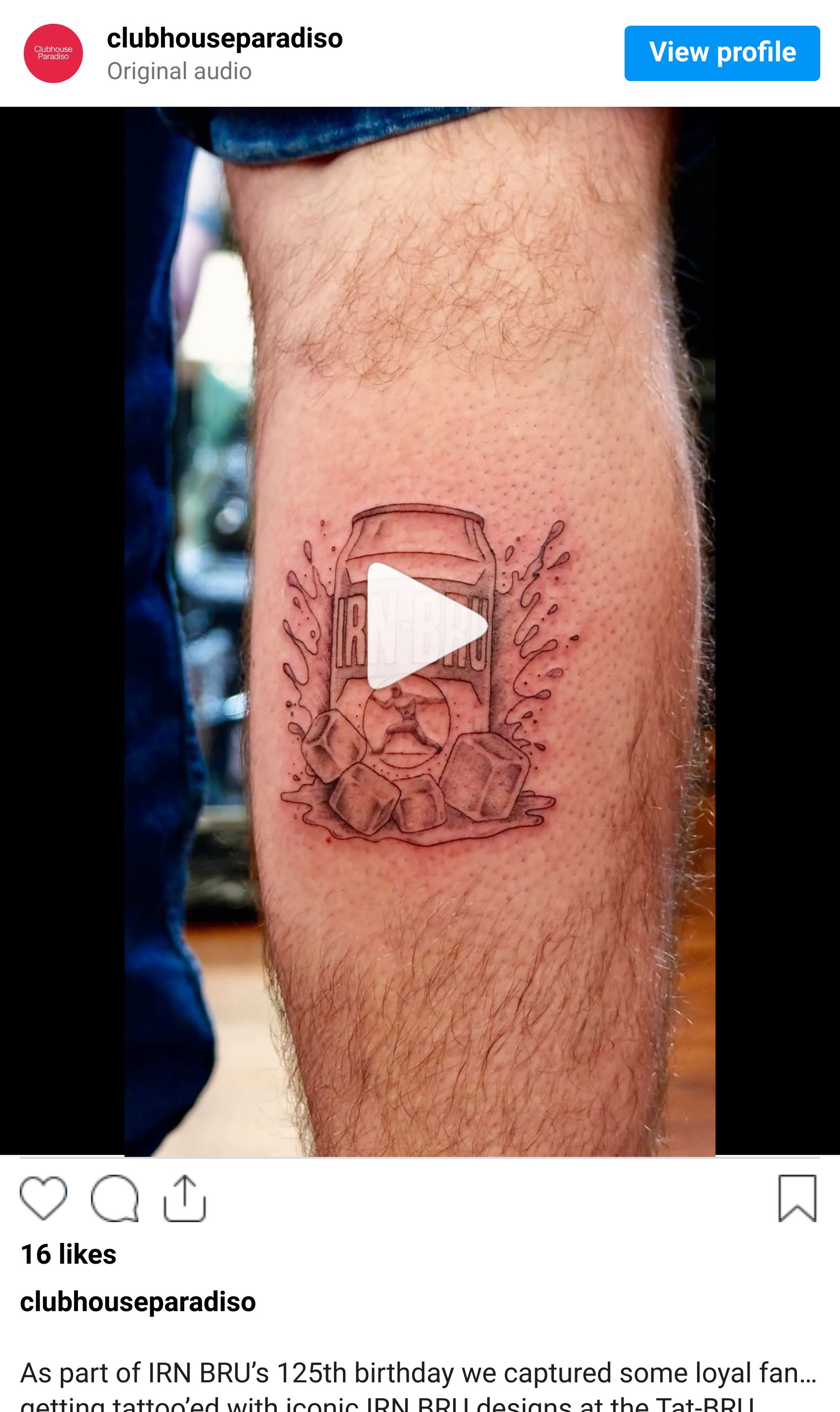
For its 125th anniversary, Scottish soft-drink brand IRN-BRU did the opposite of what most legacy brands do at a milestone year. No retrospective ad. No celebrity reunion. No nostalgic tearjerker. Instead, IRN-BRU rebuilt its can artwork into a fan-led activation called Tat-BRU — a pop-up tattoo parlor where fans could get free tattoos based on the new packaging design.
The pop-up ran in Glasgow with a queue around the block on day one. Fans showed up with reference pages from the new can pulled up on their phones. Some chose the IRN-BRU wordmark. Some chose the new orange-and-blue gradient mark. A few chose lyrics from old IRN-BRU TV ads. The ink was real. The commitment was the point.
Why we love it: Most 125-year brand campaigns are written for the boardroom — slick montages, "thank you for the journey," milestone-merch drops nobody wants. IRN-BRU did the inverse. They built one activation that only made sense if real fans showed up willing to wear the brand on their skin. That's not a brand stunt; it's a loyalty test the brand was confident it could pass. And it worked because IRN-BRU has spent decades earning the right to ask.
The activation generated organic press in The Drum, Marketing Week, Campaign UK, and dozens of UK consumer outlets, drove a packaging sales spike at Scottish convenience retailers in the activation week, and produced thousands of user-posted Instagram and TikTok videos of fresh tattoos — all without paid amplification.
The algorithm could never: No prediction model would have green-lit "free tattoos of our packaging" as a 125th anniversary play. The campaign required reading a real audience accurately enough to know they'd actually do it. Every assumption underneath it — that fans would queue, that the press would care, that the tattoos would look good enough to post — was a human judgment call about a specific human relationship. AI could optimize the rollout. It could not have proposed it.
The startup takeaway: The strongest brand activations are the ones that would be embarrassing if your audience didn't show up — which is exactly why they work when they do.
Do we dig it?
🗓️ Make Friends
FEATURED:
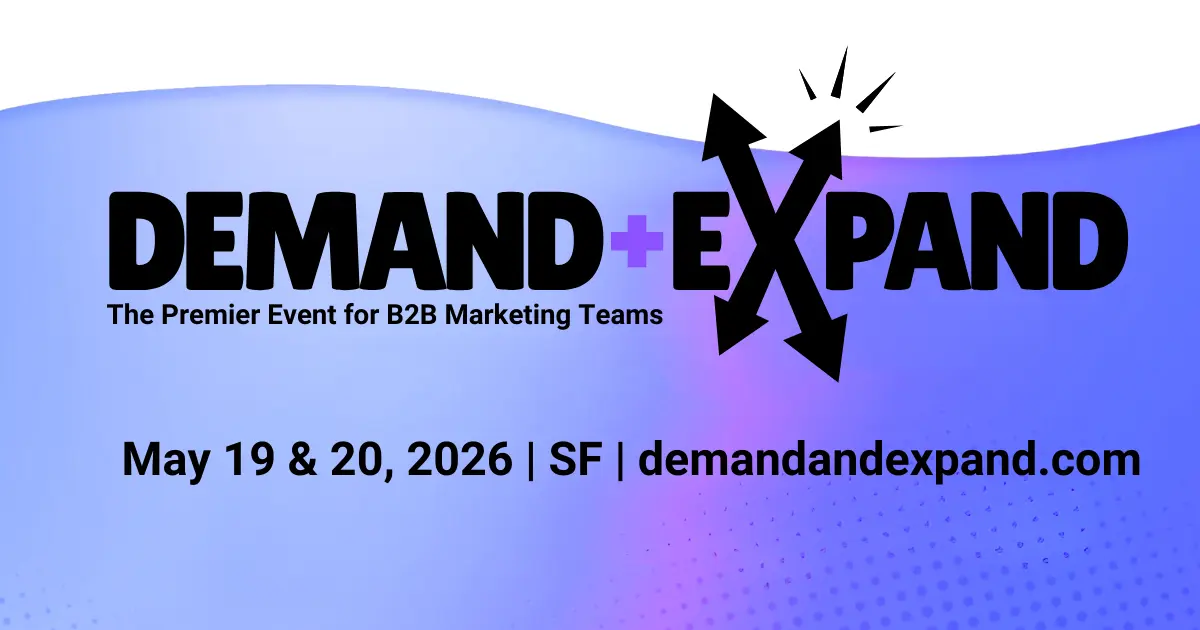
If you're a B2B startup and you can only attend one event this month, this is the one. Demand & Expand is built for the exact reality DFTA covers every week: marketing teams being asked to own the full funnel — demand gen, lifecycle, growth, revenue ops, product-led, and customer-led — while headcount shrinks and AI adoption accelerates. Two days in San Francisco. No fluff panels. The programming is organized around breaking bottlenecks between departments that need to work together but usually don't. For founders and solo marketers running content, paid, and ops simultaneously, the peer density alone is worth the trip.
Date: May 19-20, 2026
Location: San Francisco, CA
Link: Register
💼 Don't Let AI Replace You
Stripe
Position: AEO & GEO Search Marketing Manager – Remote Lead Stripe's AI search channel from scratch. Grow new user acquisition from ChatGPT, Perplexity, and Google AI Overviews. The job description reads like a DFTA curriculum: LLM Search Optimization, answer engine optimization, agent experience. 7+ years SEO with recent full-time focus on LLMO/AEO/GEO. This is the role. → Apply NowExperian Health
Position: AEO & SEO Manager – Remote Pioneer AEO at one of the largest data companies in the world. Own the new path to AI search visibility for Experian's healthcare division. $100K-$174K. Enterprise scale, startup-like mandate. → Apply NowOneTrust
Position: Senior Growth Marketing Manager (SEO, AEO) – San Francisco / Atlanta Lead organic and AI search growth at the privacy and trust platform. AEO is in the title, not an afterthought. Posted April 13. → Apply NowLaunchDarkly
Position: Senior SEO & GEO Marketing Manager – Remote Build the GEO program for the feature management platform. SEO and GEO combined in one role — exactly the convergence we've been writing about. Posted April 14. → Apply NowOdoo
Position: Growth Marketing Specialist, GEO & AEO – Buffalo, NY Optimize for visibility across ChatGPT, Perplexity, and Gemini for the open-source ERP platform. $75K-$95K. Entry-to-mid level — good first GEO role. → Apply NowCapital One
Position: Senior Digital Marketing Associate – AEO, GEO & AI Search Lead – Remote Financial services premium comp. Lead AEO/GEO strategy for one of the biggest consumer brands in the country. If you want to do this work at scale, this is the scale. → Apply NowAmerican Express
Position: Director, Enterprise Agentic Search – New York, NY (Hybrid) This might be the most important AEO role posted in 2026. Define how Amex adapts to AI-driven and agentic search across every market and business unit. Direct partnerships with Google, OpenAI, and Perplexity. The title says "Agentic Search." The scope says "future of the company." $123K-$215K + bonus + equity. → Apply NowHonda
Position: AEO/GEO Specialist – Torrance, CA (Hybrid) Hands-on execution role optimizing Honda's marketing site across Google, ChatGPT, and emerging AI discovery channels. Schema markup, entity relationships, content architecture. Long-term contract through March 2027. One of the first automotive AEO roles. → Apply NowADT
Position: Director of Discoverability, AEO/SEO – Irving, TX "Director of Discoverability" is one of the best job titles in marketing right now. Lead AEO and SEO for one of the most recognized home security brands in the country. Enterprise leadership comp. → Apply NowZola
Position: Director of SEO/AEO – Remote Lead organic search and AI discoverability for the wedding platform. Strong emphasis on content strategy and AEO. Director-level with full ownership of the channel. If you want to build AEO at a consumer brand people actually love, this is it. → Apply NowSmartBug Media
Position: SEO/AEO Strategist – Remote Agency-side AEO role at a full-service digital agency. Work across multiple clients building AI search visibility. Good option if you want breadth across industries instead of depth at one brand. → Apply NowFreedom Leads
Position: SEO/AEO/GEO Content Specialist – Remote (Freelance) The job description reads like a DFTA syllabus: "answer-first formatting," "entity-based optimization," "AI readiness." High-velocity agency looking for someone who knows the difference between ranked and cited. Posted this week. → Apply Now
Ad Age published a salary guide this week specifically covering AEO/GEO job growth — featuring roles at American Express, Circana, UPS, and Publicis. The article opens by stating that AEO and GEO are being added to SEO titles across the industry.
Six months ago this section featured companies with GEO as a "preferred skill." Now it's in the job title. Next quarter it'll be in the budget line. The window to build this expertise before it becomes a baseline requirement is closing fast.
Getting certified first → Averi Academy
Know of a GEO or AI content role that should be here? Reply with the link and we'll feature it next week.
Did You Know? — YouTube now appears in roughly 16% of AI-generated answers — overtaking Reddit as the #1 most-cited domain across all major AI platforms. LinkedIn jumped from rank 11 to rank 5 on ChatGPT in just three months.
The citation leaderboard isn't stable. It's a race.
Til next time,
